June 4th, 20205.
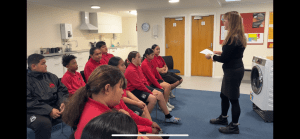
Today’s extension was a little different from our usual ones. This time, a lovely lady named Jennifer—who works at Fisher & Paykel—came in to teach us about washing machines! Now, I didn’t think it would be that exciting to be honest.. But after coming back, my thought on it has changed completely.
For starters, we learnt about how a washing machine actually works, and the different cycles of one. Did you know that certain soils affect the way you have to wash them, as in the different cycles? I didn’t. And there are certain foods that affect this too.
Next up, we got to look around in the machine from above—as it was clear—and started identifying different parts of the washing machine. The machine is on a horizontal axis with a motor in the back that spins when the machine turns. At the top, there is a block on cement that holds down the machine when it spins to help stabilize it.
Then we started listing down the different reactions that a washing machine needed to actually work. There are 4; Chemical action, Mechanical action, Thermal action, and time. For a washing machine, the chemical actions are the detergents that you put in. The mechanical action is elictricity, like the power and energy that the machine needs. The thermal action is the temperature, and in the back of a washing machine we have 2 holes that you attach a tube into. One is red and the other is blue, which is also known as hot and cold. Did you know that when you put hot water in it, it actually cools down inside, so it actually has a heating element that heats it up. This is the thermal action. Next is time, where you have to set up the machine to spin for as long as you want it to.
After we identified each of the elements that a washing machine needs, we moved on to a science experiment. This one had to have 4 people, and this time we were checking how you can tell that the machine is legit, and it actually washes the clothes properly. So, we made a 4×2 table for each of the 4 bottles, with the chemical and mechanical actions on the side. We first listed it out on like this; low low, low high, high low, high high. Then we put the swatches that the company uses to test how proper the machines are inside the bottles. After this, we made theories—which soon became a hypothesis—on which we thought would be the cleanest, cleaner, dirtier, and dirtiest.
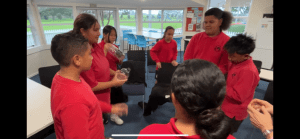
So, we got split up into 2 groups where one team had the 2 we theorized to be the dirtiest, and the other team had the other 2 that we thought would be the cleanest. We got into a circle and each person had to shake the bottle before passing it onto the next person. We then did this twice with both bottles, and after that, I got to help with pressing the swatches.
To press the swatches, Jennifer sent me and one other person to bring them over to the sink where we place it on top of a paper towel and fold it before pressing down harshly. It was pretty easy. Then we had to go give it to our teacher, Mrs Burton, where she ironed them out on each side.
For the last thing we did, we looked at all 4 cloths we tested on and saw a difference between each. Turns out, our theories were wrong. The one we thought would be the cleanest, was actually one of the dirtiest! I was not expecting that.
But all in all the experience was great, and it had soon come to an end. Jaxon gave a speech on behalf of our group to Jennifer, and we thanked her in the end. The experience was truly unforgettable, and I even got a little into science too.
Thank you Jennifer for the amazing lesson you gave us! I hope the next time you come is just as fun.